Wednesday, May 19, 2010

Viruses Store and Deliver Keys to Evolution


  • Scientists like Forest Rowher, believe that virus' called phages can act as gene transporters for bacteria.
  • With an estimated 10,000,000,000,000,000,000,000,000,000,000 phages on the earth, and the facts that antibodies kill bacteria but not viruses, and can switch environments very rapidly, it would make perfect sense for viruses to carry evolutionary advantages.
  • By using a process called metagenomics, scientists found that the genetic profile of viruses and bacteria in different environments was very distinct.
  • There are many times when viruses won't kill the bacteria they have infected, supporting this theory, and genes related to movement of bacteria have been found in viruses, suggesting that they can "control" instead of kill the bacteria during infection.
  • Other viruses have been found to contain genes that allow the "consumption" of substances that bacteria cannot normally eat, unless the virus gives them the genes.
Reflection:
This story caught my eye because it presented a completely different viewpoint than that which I normally looked at viruses through. Before, I would have said, if anything, that viruses could only slow down evolution, because all they do is wipe out populations of cells very quickly. However, this article shows that despite the destructive nature, they can provide a collateral advantage instead of damage. along with some of the other articles I have read, this article makes it seem like almost anything can be bent to the will of humans. I would imagine that the next step of this discovery would be to give viruses certain genes and then inflict them upon bacteria to control the bacteria.

Source:
Bryner, Jeanna. "Viruses Store and Deliver Keys to Evolution - LiveScience- Msnbc.com." Breaking News, Weather, Business, Health, Entertainment, Sports, Politics, Travel, Science, Technology, Local, US & World News- Msnbc.com. Web. 19 May 2010. .

Female Komodo Dragon Has Virgin Births

  • At the Chester Zoo in London, a female Komodo dragon that had been living alone recently laid 25 eggs, 11 of which hatched.
  • Scientists discovered that where normally the only one of the four egg cells produced by meiosis would survive, in rare cases in certain animals, one will become an egg while another will act like a "surrogate" sperm cell.
  • This process, know as parthenogenesis, does not, however create clones of the parent due to the mixing around of the genes during meiosis.
  • Hypothetically, this would allow a single komodo dragon to create an entire population, although it would have severely decreased genetic diversity, and many problems could arise due to the inbreeding that would follow.
Reflection:
I chose this story because i thought it strange that a single lizard could act as a mother and a father while giving birth to new offspring. If not for the rate of extinction at which komodo dragons are dieing off, this would allow them to increase their population at staggering rates, which I would guess would completely throw the ecosystem out of whack. I also found it interesting that one egg cell could so quickly and easily make such a dynamic change in its function. This is very much like stem cells which remind me of a story where a man uses the stem cells of a lizard to bring them back from the dead. Also this article brings to mind the recent video "Why Sex?"

Cuckoos, Wrens in Escalating Evolutionary Arms Race


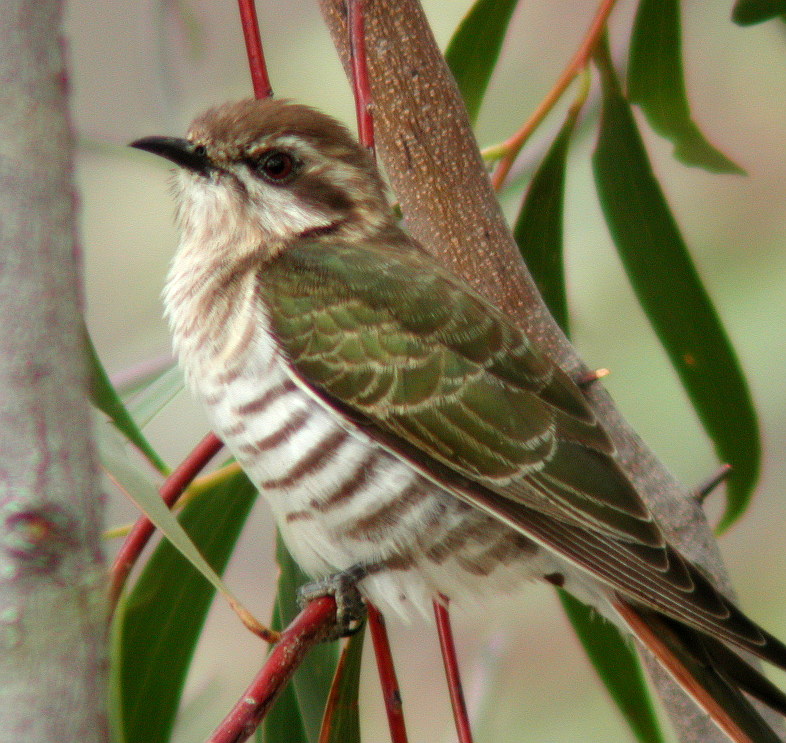
  • The Horsefield's bronze-cuckoo lays its eggs in the nests of other birds which most birds can usually identify as cuckoos before, but never after, the eggs hatch.
  • However, superb fairy-wrens in Australia, who are bad at telling the eggs apart due to dark enclosed nests, have begun to adapt to recognize cuckoo hatchlings, and will leave them behind.
  • To combat this, the Horsefield's bronze-cuckoos evolved to more perfectly match the calls of the fairy-wrens, rendering distinction almost impossible.
  • With fairy-wrens unable to distinguish between egg type and hatchling call, it would seem that they would be doomed, but instead they just wait for the cuckoo to hatch.
  • When the cuckoo hatches, it will push out all of the wren eggs, and the parent wren will discover the true identity of the impostor, taking advantage of Australia's long hatching season and re-nesting.
Reflection:
I chose this story because it proved to be a good clear example of an evolutionary arms race. I also had never heard of birds tricking other birds into taking care of their young for them. Another thing i found interesting was how the hatched cuckoos instinctively pushed all of the other eggs out of the nest. How even innocent baby birds could turn out to be ruthless contenders in the arms race was quite amazing. What I learned from reading this was that an evolutionary arms race is not always just a battle between two traits in two organisms like with the salamanders and the snakes, but that the species in the race can employ a much sneakier and wider range of tactics too.

Sources:
  1. Owen, James. "Cuckoos, Wrens in Escalating Evolutionary Arms Race." Daily Nature and Science News and Headlines | National Geographic News. Web. 19 May 2010.
  2. Drew, Ray. "Birds of South Eastern Australia." Untitled Document. Web. 19 May 2010. .
  3. "The Escalating Coevolutionary Arms Race between Cuckoos and Their Hosts : Living the Scientific Life (Scientist, Interrupted)." ScienceBlogs. Web. 19 May 2010. .

This Germ Could Save Your Life


  • Microbiologist David Thaler is one of the primary advocates for using genetically modified bacteria to fight disease instead of cause disease; however, this idea is having a very difficult time of becoming a reality due to the the difficulty being able to perform live tests, on actual people.

  • This could become a reality with Jeffrey Hillman's research, which began with him setting up a series of cage matches between colonies of Streptococcus mutans, the sugar-eating bacteria that commonly cause tooth decay, to create a species of super bacteria that could easily wipe out all other bacteria in a person's mouth.

  • The difference between these bacteria and their weaker counterparts, is that the genetically modified S. mutans contains a gene from Zymomonas mobilis, used in Mexican beer, so that the S. mutans will produce a harmless alcohol as waste instead of a tooth-destroying acid.

  • Later, due to regulations from a special board on the FDA, the bacteria were made to be dependent on a certain amino acid which was made into a special mouthwash to prevent the uncontrolled spread of these bacteria.

  • Finally, a in 2006 the bacteria was tested on real people (under heavy laboratory conditions though) and, as predicted, was a success, although it has yet to be tested freely on people with actual medical conditions in an actual environment.

Reflection

When I first spied this article, I thought having bacteria work for me to clean my teeth might be interesting, especially because I have braces, which make it extremely hard to brush and floss my teeth. However, as I read further, I realized that this could become the domestication of bacteria, and the domestication of plants and animals had been such a huge event that it had changed the entire world forever, and enabled a huge leap in progress, the creation of cities include. If more bacteria were “domesticated”, I thought, this would be like the Agricultural revolution from the Neolithic times. In fact, I wasn't at all surprised when one of the scientists described it as “the second Neolithic Revolution” later in the article. As I continued reading, it just seemed like such an ingenious plan that people would be able to “tame” bacteria to do their bidding. On the downside, though, I think that their could be a lot of risk involved in thrusting “safe” bacteria upon humans. The way I see it, scientists will only have one chance to impress the public with this new technology, before it is destroyed by rumors and hysteria.

Source:

Sachs, Jessica S. "This Germ Could Save Your Life | Popular Science." Popular Science | New Technology, Science News, The Future Now. Web. 19 May 2010. .

Sunday, May 16, 2010

Being Bad at Relationships Is Good for Survival


  • According to researchers, evolution has naturally split humans into two distinct groups, those emotionally secure, and those emotionally insecure, and recent studies have shown why.
  • An experiment was set up to simulate different groups of people in a building which had just begun to catch on fire, and groups containing more insecure people consistently reacted more quickly than those who did not.
  • The scientists concluded that although an emotionally secure person will do better in relationships, which is a natural evolutionary advantage, their self-created sense of security causes them to react more slowly to immediate dangers.
  • Conversely, more insecure people, will be much more aware, and not lulled into the sometimes false sense of security that strong group connections can provide
Reflection:
I found this article to be so interesting because it really demonstrates how two different adaptations can both be beneficial at the same time. Either be better at finding a mate and thus be able to reproduce more, or be more aloof but better at surviving, and thus being able to reproduce more. Typically, any example of natural selection I would have thought of would contain only one favored trait, but never would I have imagined that two practically opposite traits could both coexist and help survival. This is very much similar to the video we watched in class about the peacocks. Even though the bright feathers of a peacock slowed it down, hindered its flying ability, and made it stand out to prey, females would only choose mates who had these brilliant feathers. Just as interesting is the fact that such contradictory adaptions could even arise; after all, it would be much more beneficial for there to be one definitively better trait. Such a peculiar quirk in our evolutionary path has truly produced a double-edged evolutionary sword.

Source:
Minkel, JR. "Being Bad at Relationships Is Good for Survival | LiveScience." LiveScience | Science, Technology, Health & Environmental News. 15 May 2010. Web. 19 May 2010. .

After Years of Herbicide Use, Roundup-Resistant Superweeds Are Evolving to Invade U.S. Fields


  • Through overuse of the herbicide "Roundup" produced by Monsanto, weeds have begun to take on the natural course of evolution and become resistant to Roundup.
  • Unfortunately for Monsanto, this renders their genetically modified "Roundup Ready" crops, which were designed to be immune to Roundup so that the two products could be used alongside each other.
  • 90% of soybeans, 70% of corn, and 70% of cotton in the US are having to be protected from weeds through use of even stronger herbicide, ultimately harming the environment and lowering crop yields, meaning higher food prices for everyone.
  • This event is much akin to the overuse of anti-malarial drugs that caused malaria to be so deadly today.
Reflection:
This was a perfect article for me to read this year due to the excellent amount of background I have had, such as the GMO video and Food Inc. From videos and class lessons like these, I really could have predicted literally everything that happens in this article. It is very strange how such a huge and powerful company like Monsanto could be so caught off guard by such a foreseeable and natural event, that almost any high school biology student could predict. Of course, there is the possibility that Monsanto was fully aware that this would happen. After, they are such a big company that the only people who are really damaged by this are the farmers and consumers. Then Monsanto could make a new herbicide and new plants and the mind boggling number of farmers who use Monsanto's products would have to buy completely new ones all over again. Mark my words, as sure organisms evolve, Monsanto will evolve its products, and its profits, very soon.

Dillow, Clay. "After Years of Herbicide Use, Roundup-Resistant Superweeds Are Evolving to Invade U.S. Fields | Popular Science." Popular Science | New Technology, Science News, The Future Now. 4 May 2010. Web. 16 May 2010. .

Sunday, May 9, 2010

TED 2010: Halting Blood Vessels Key to New Cancer Treatment; Possibly Obesity


  • Dr. William Lee has recently made the connection that the treatments for cancer and obesity could be very similar, as both required a steady supply of blood to develop, making both prone to angiogenesis inhibitors.
  • Connecting these two, he realized that perhaps diet could have a major impact on cancer, similar to its effects on obesity.
  • Testing different foods, he found that extracts from foods like red grapes, strawberries, and soybeans could have an impact, and some, such as jasmine and sencha teas, would undergo a great increase in potency if combined, implying that the right combination of foods is the key.
  • When tested alongside current major angiogenesis inhibitors known as statins, some foods actually showed more potential than the drugs, not to mention the obvious extra nutritional benefits provided.
  • When similar tests were performed on obese mice, it was found that stricter regulation of angiogenesis could actually allow scientists to "cycle" the mices' weight up and down.
This is certainly an uplifting article; should more research show positive results, it would mean a simple, inexpensive way to control, health, obesity, and cancer all in one. If the results were to get enough publicity, it would force a major food overhaul in places like restaurants and supermarkets. Healthy food is definitely something that is very much needed in this country, and I do try to eat healthily, but it would be great if I did not have to try and food producers made better food instead of cheaper food. This would ultimately be a major success in the overall health of the entire country and others, especially seeing how those with less money would have the same edge in fighting off these diseases as the more wealthy. This is truly the type of research that needs to be done, research that will benefit all people, not just those who can afford it. Also the group of foods, which can be seen in the picture, is quite diverse as far as coming from different parts of the world, meaning other countries could benefit. In closing, this approach of looking from one angle at two approaches should be more widely used, as it would benefit all fields of almost everything.

Source:
"TED 2010: Halting Blood Vessels Key to New Cancer Treatment; Possibly Obesity | Epicenter | Wired.com." Wired News. Web. 10 May 2010. .